

Three Rocks
Bill Griffith tells the story of Ernie Bushmiller and is intentionally outshined in the process.


As with most things comics-related, I have to admit my admiration for Nancy is very recent. I started reading comics again in late 2019—after nearly a decade away from the medium—and it felt like even the things that were familiar to me were an education. I learned to read in the early nineties when Peanuts and Calvin and Hobbes were the top-billed comic strips. The latter was especially impactful to me as a child, and it was a strip I continually rediscovered. In middle school, my English teacher Mrs. Lehman gave me a copy of There’s Treasure Everywhere because I reminded her of Calvin (for better or for worse). She noted that I loved to draw, and wanted to encourage me in that. To my shame, I didn’t stick with drawing, but I have my copy of that book to this day, along with her post-it notes on certain strips that highlighted my egregious behavior. My love for Calvin and Hobbes was recaptured yet again when I gave a stack of volumes to my kids and I got to experience it through their eyes.
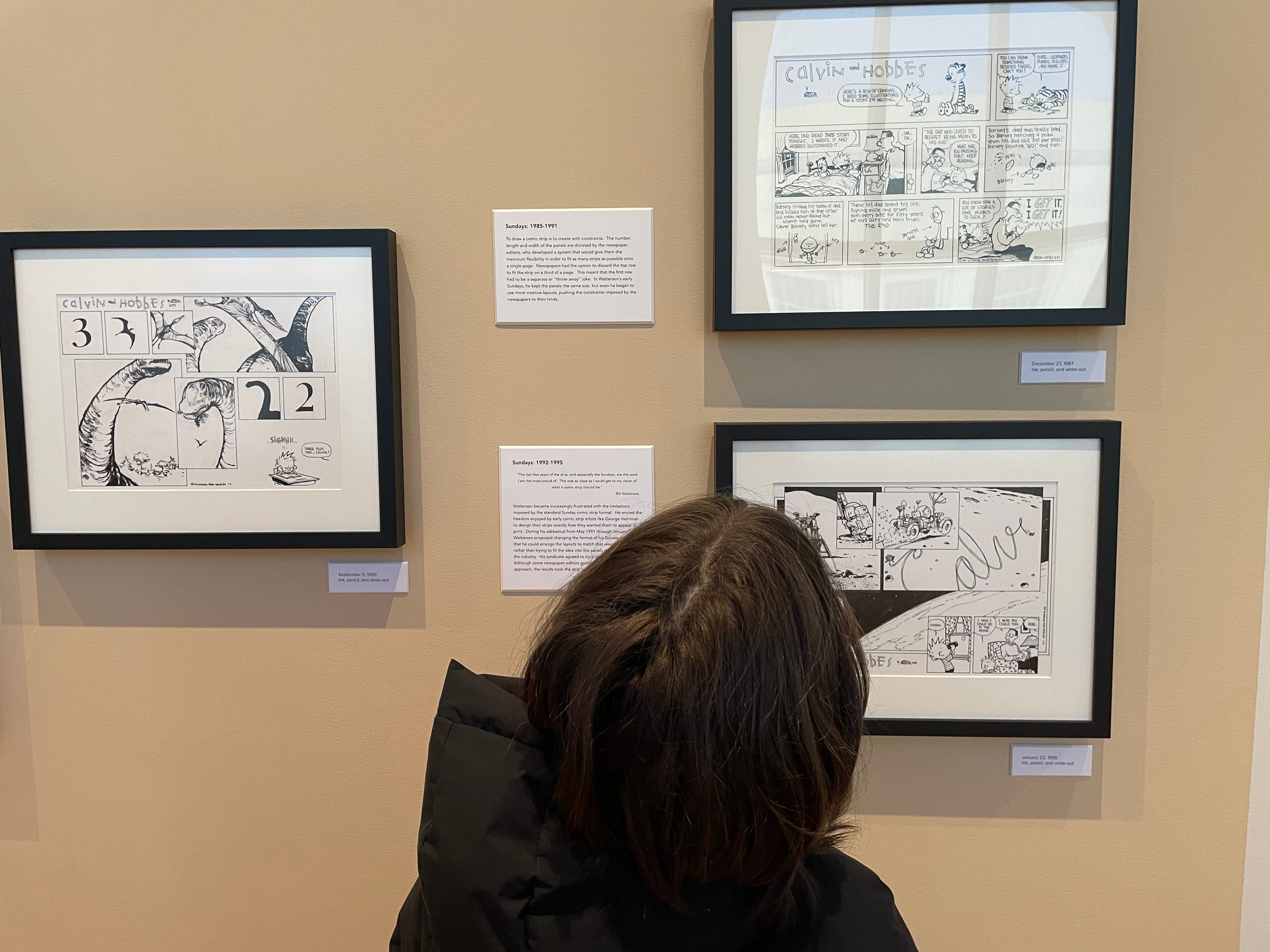
Bill Griffith doesn’t have much affinity for Calvin and Hobbes, though. In a 1995 interview in Goblin Magazine, he said, “Everyone says Calvin and Hobbes is about a real kid, but to me there's nothing real about it; it's clearly the voice of an adult in a kid's body. It doesn't make much sense to me.” I never really understood the idea that comic characters needed to be empathetic, but the empathy we feel from Peanuts and Calvin and Hobbes is what gives those comics their power. Empathy isn’t what makes us love Calvin or Charlie Brown more. The emapthy we feel for these characters is doing something much heavier than that: it is making us understand who we are. The empathy we feel for these characters—whether they are children or adults in child bodies—helps to constitute us as persons. We come to know who we are, even that we are, through this empathic turn.
But Nancy doesn’t do that.
In his self-assigned role as the museum curator and guide at the entirely imaginary Bushmiller Museum of Comic Art, Griffith examines the phenomenology of Nancy. The comic is not about “childhood” but rather “comic-strip-hood.”
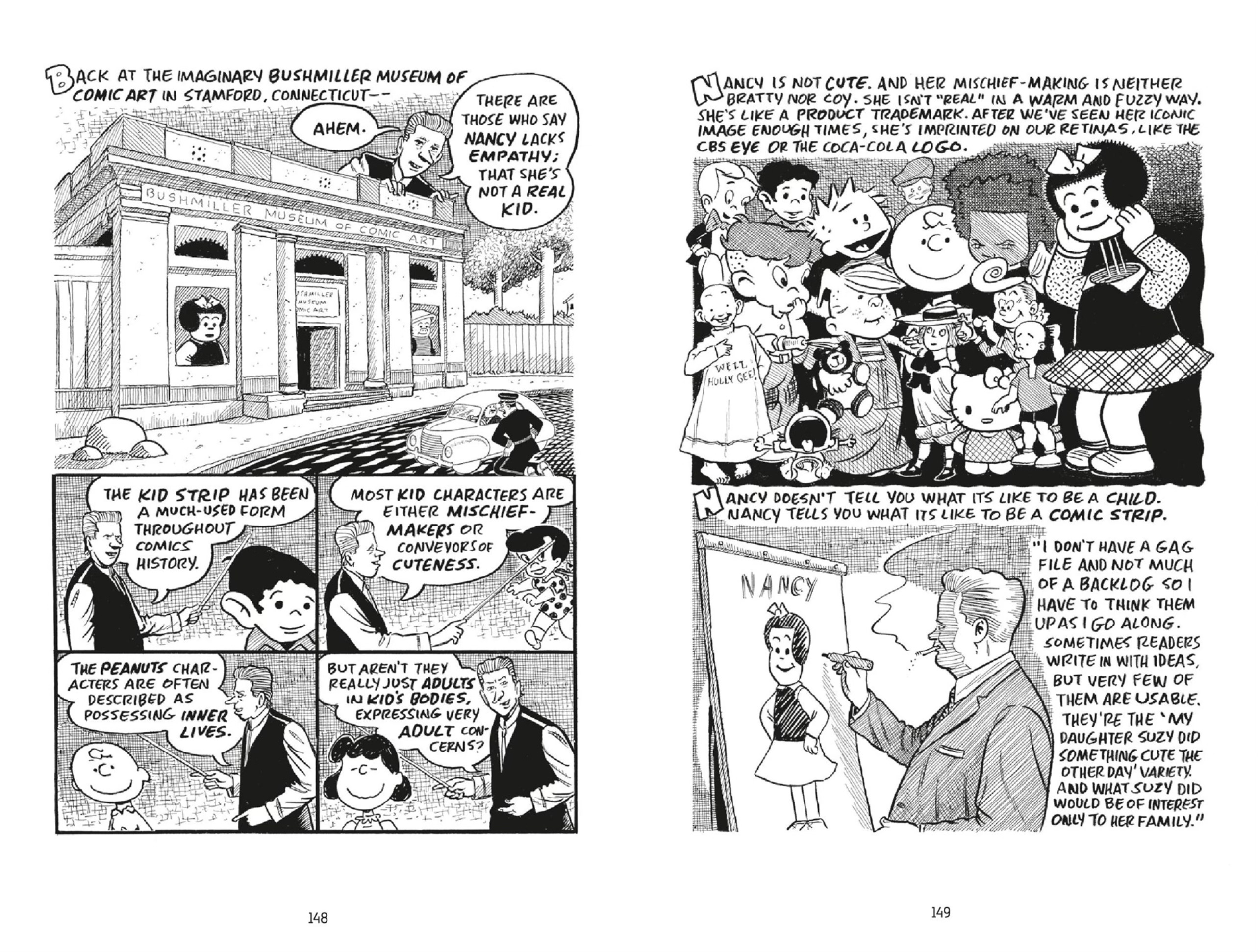
There is no “realness” of Nancy. She doesn’t reveal to us anything about ourselves. She isn’t meant to be a mirror by which I reveal myself to myself. Nancy just…is.
And damn it, she is funny.
Three Rocks: The Story of Ernie Bushmiller, The Man Who Created Nancy is the third in a trilogy of biographies by Griffith, and is maybe the most lovingly told. There is a certain sense of wonder and awe as Griffith not only looks at the life and career of Ernie Bushmiller, but as he examines Bushmiller’s creative process behind Nancy and its timeless genius.
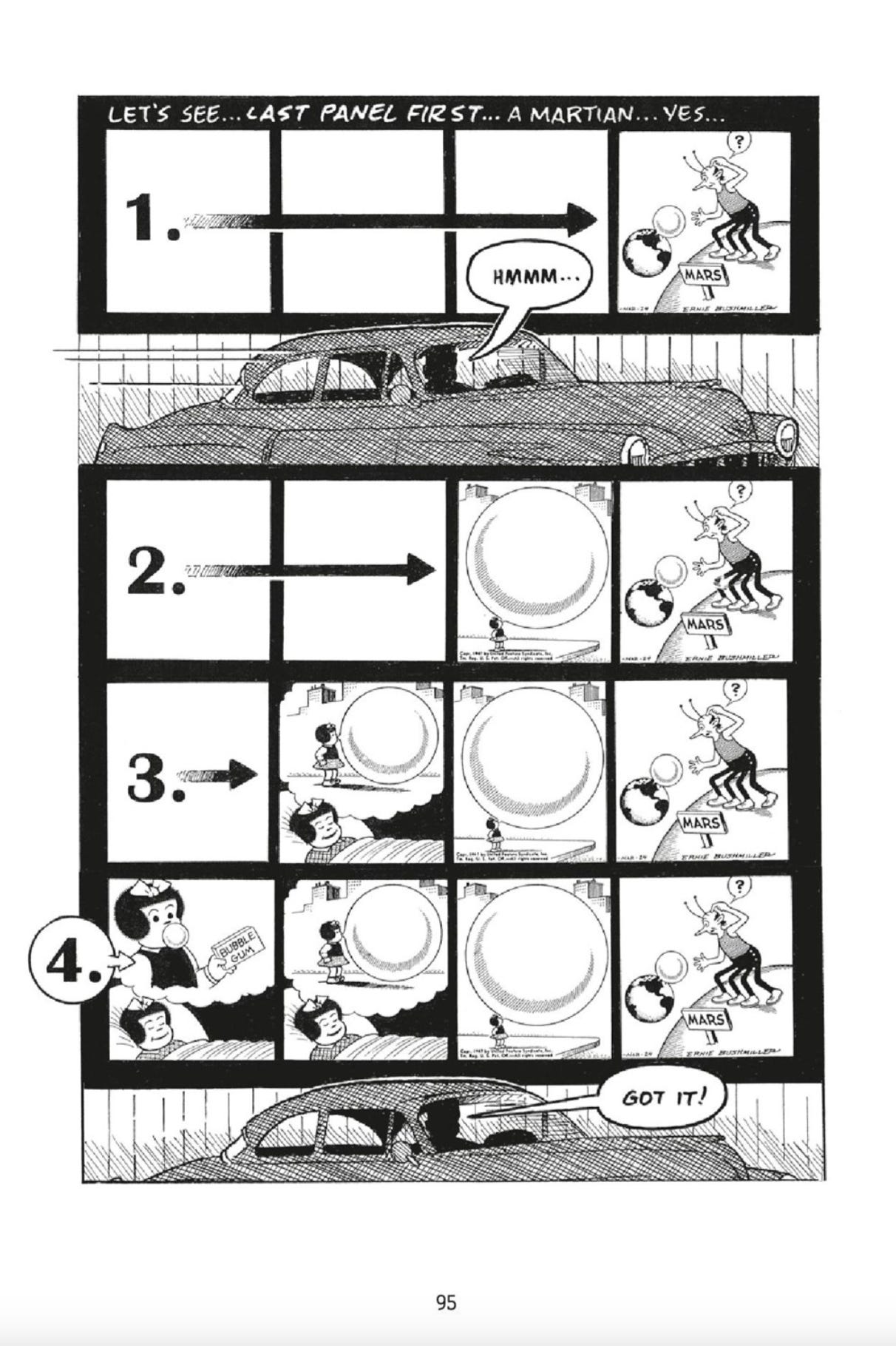
At the core of Nancy is its beautiful simplicity. Across just a handful of panels, the gag unfolds. He would begin with the “snapper”—the punchline of the strip—and develop them backwards. The ones that he couldn’t quite figure out were filed away for later consideration. I don’t know how much later those would be saved, because Bushmiller was really churning these strips out. He worked on all of his strips for a week in a single session, hopping from one to the other, penciling, lettering, inking until they were all complete.
“Dumb it down” is the Bushmiller credo. But by this, Bushmiller didn’t mean to make the comics dumb. He meant that the strip needs to be accessible, readable. Moreover, it needed to be understandable to the average person. If a strip was too cluttered, or used too many words, or required just too many steps to make sense, it needed to be either reworked or scrapped entirely. Griffith, in an interview with John Kelly in The Comics Journal said, “There's thousands, or hundreds, of dumb comic strips. Nancy isn't one of them.” I have to agree with him.

Griffith’s reverence for the Nancy material doesn’t end at its ability to make a gag. Throughout Three Rocks, we are inundated with countless images of Nancy and Sluggo. What surprised me upon finishing the book was seeing that every appearance of the two in the book was drawn by Bushmiller himself (or by another cartoonist that worked on Nancy to make a point). In some instances, Nancy and Sluggo are collaged, but Griffith refused to draw them. This is an almost religious devotion to Bushmiller and Nancy, that to even touch the sacred objects must be done with reverence. Undoubtedly, Griffith had Bushmiller’s perfectionism in mind. Everything about a Nancy strip had to be just right. A particularly memorable sequence has Al Plastino describing his work on the Nancy Sunday strips, saying Bushmiller would call 20 times per day, that he would have to file down his pen nibs, and use a crow quill to individually draw the hairs on Nancy’s head.
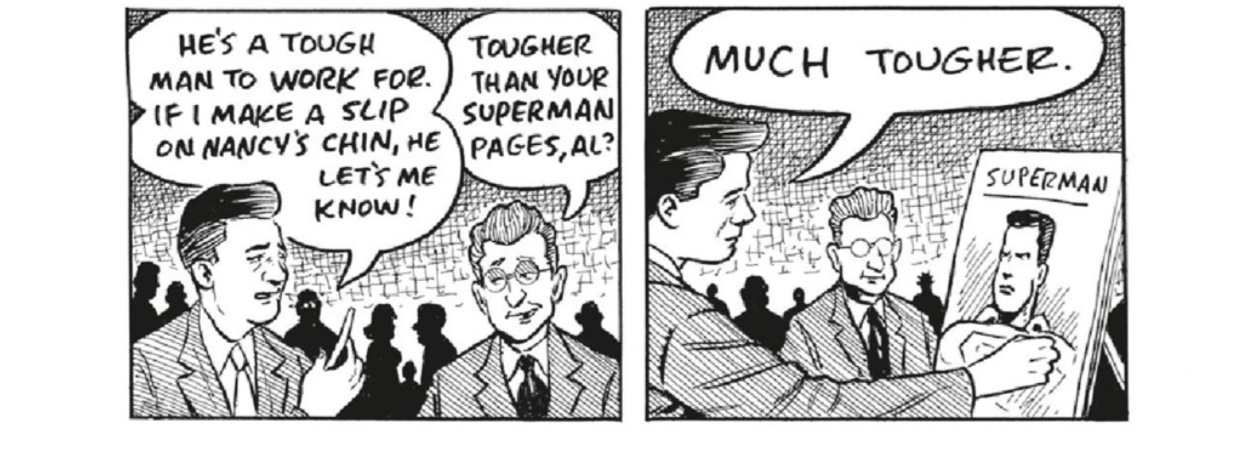
No wonder Griffith decided to let Bushmiller retain those duties, even 30 years after the latter’s death.
Nancy is an ongoing comic strip, now in its 92nd year of publication—103rd, if you go by the creation of the Fritzi Ritz strip, the predecessor and aunt of Nancy’s eponymous heroine—to mixed reviews. Purists would much rather the strip concluded, whereas some readers find it to be a refreshing new spin on the character. As something of a Johnny-come-lately, I can’t give a completely informed opinion. Olivia Jaimes—the current, pseudonymous cartoonist—is making a strip very different from Bushmiller’s Nancy, not only in tone, but in style. And its a style that seems to be constantly changing. I’m not against it, at least in principle, but it is a very different strip. I can say that, as a newer fan of Nancy, I find myself returning to Bushmiller as much as possible instead of reading new strips. They just make me laugh in a way that Jaimes’ don’t. And that’s what I need.
Bill Griffith’s book is wonderful. It is among the great comic biographies I have read, and it is really two books in one. Nancy and Bushmiller are intertwined, the latter’s life inseparable from the art he created. But Three Rocks is also a handshake, an introduction to someone you need to meet. Nancy’s spiky hair and bow, the simplicity of her face, and the antics she gets up to will become engrained in your mind.
Wally Wood (allegedly) said of Nancy, “By the time you decided not to read it, you already had.” I had the exact same experience with Three Rocks.
👏 If you haven’t already, I definitely recommend grabbing “The Nancy Show” - it’s the published catalog from the Billy Ireland’s Ernie Bushmiller exhibit last year, and it is AMAZING. Keep writing about comics!